Professional Laser Hair Removal Machines
Factory-direct laser hair removal machines built around the 808nm diode wavelength — 800W output, advanced contact cooling and safe operation across all Fitzpatrick skin types. Supplied to clinics, med spas, salons and distributors, with 7-level OEM/ODM customization.
What Is a Laser Hair Removal Machine?
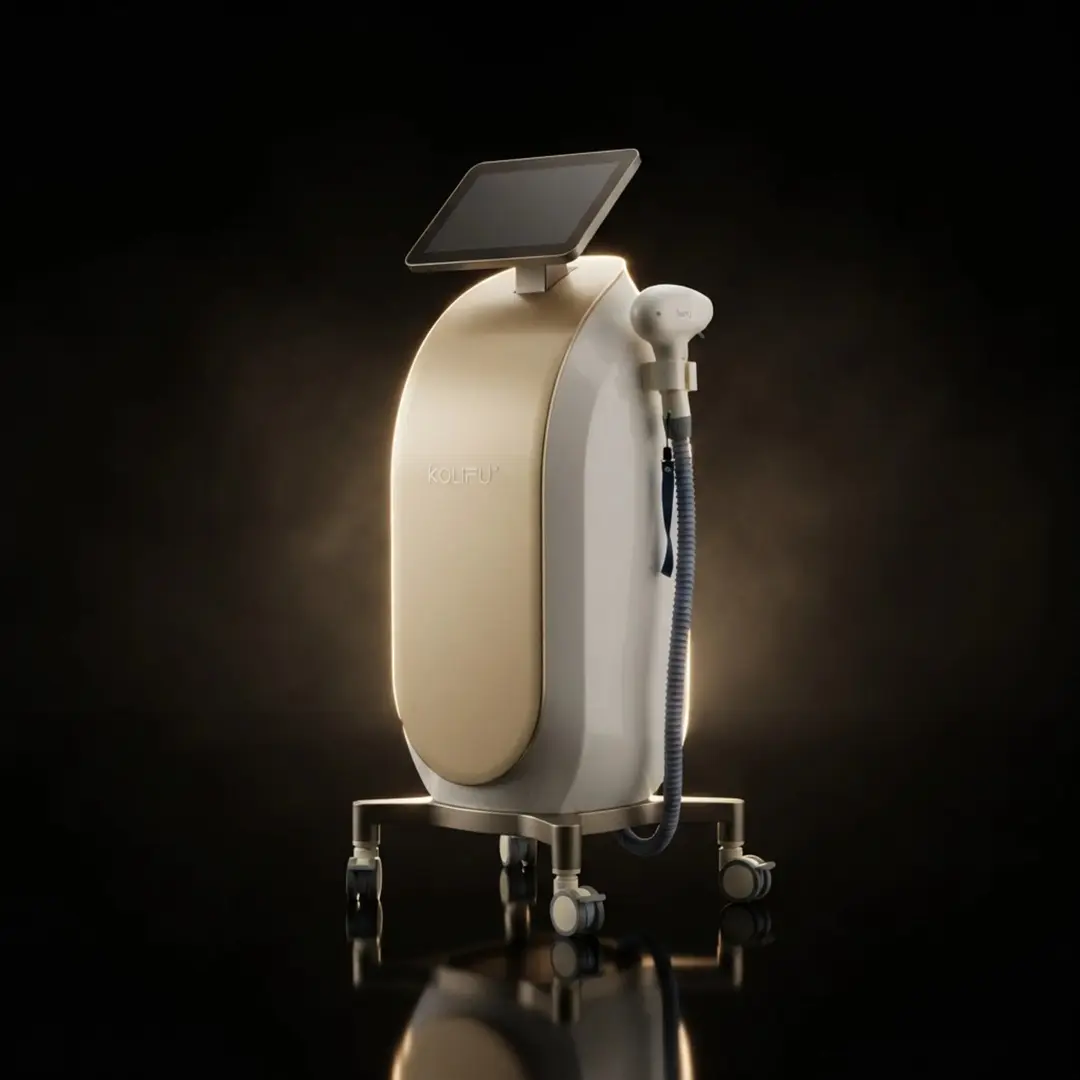
A laser hair removal machine is a professional-grade device that permanently reduces hair growth by targeting the melanin inside the hair follicle. The handpiece emits a concentrated beam of light at a specific wavelength; melanin absorbs that light, converts it into heat, and the follicle loses its ability to regrow hair. Because the energy is selective — absorbed by pigment rather than by the surrounding tissue — the skin around the follicle stays intact.
The technology has four moving parts worth understanding before you buy. Wavelength decides which skin tones and hair colors you can safely treat. Power output decides how fast you can work through a treatment area. Pulse duration and repetition rate decide how aggressively you can push a single pass. And cooling decides whether the client comes back — a machine that overheats the epidermis is a machine that limits the fluence you dare to use.
That combination is why two machines of the same wattage can behave completely differently in a treatment room, and why a professional laser hair removal machine is specified by more than its headline number.
A laser hair removal device built for clinic use is not the same class of product as a home laser hair removal kit. The professional unit trades convenience for the power, cooling and duty cycle needed to run appointments back to back, all day, on a schedule you do not control. When you buy professional hair removal equipment, what you are really buying is throughput — which is why a clinic-grade laser hair machine and a consumer device can look broadly similar in a photograph and behave nothing alike in a treatment room.
Why the 808nm Diode Wavelength
Professional hair removal has converged on diode technology for one practical reason: 808nm sits in the sweet spot between how deeply light penetrates tissue and how strongly melanin absorbs it. Shorter wavelengths are absorbed very efficiently by melanin, which also means they are absorbed by the melanin in the epidermis — a problem for anyone above Fitzpatrick type III. Longer wavelengths reach deeper but need far more energy to do the same work.
At 808nm, a diode laser reaches the follicle with enough residual energy to disable it while leaving more of the epidermis untouched. In practice this means a single diode laser hair removal machine can treat the full Fitzpatrick I–VI range rather than reserving darker skin tones for a separate long-wavelength platform. Clinics that serve a mixed clientele get one machine that covers the menu instead of two that each cover half of it.
If you are comparing an epilation diode laser against other options, the wavelength is the first column you should read — not the price and not the wattage. Whichever diode laser epilation platform you shortlist, check the wavelength before anything else on the sheet.
How to Choose a Professional Laser Hair Removal Machine
Six checkpoints that separate a machine you can build a service around from one you will resell within a year.
| Checkpoint | What to look for |
|---|---|
| Wavelength | 808nm covers Fitzpatrick I–VI in one handpiece. Confirm whether the supplier offers 755nm or 1064nm add-ons if your market skews very fair or very dark. |
| Power output | Higher output means shorter full-body sessions and higher daily client capacity. 800W is a genuinely professional duty cycle rather than a marketing figure — ask for the continuous-operation rating, not the peak. |
| Spot size | Large spots speed up legs and backs; small spots are needed for the upper lip and ears. Ask which spot sizes ship with the handpiece and whether spares are separate. |
| Cooling system | Contact cooling protects the epidermis and is the single biggest driver of client comfort. It is also what lets you run higher fluence on darker skin safely. Verify it is integrated, not a separate consumable. |
| Consumables and duty cycle | Laser bar life, handpiece replacement cost and whether the supplier will still stock parts in three years. A cheap machine with unsupported consumables is the most expensive machine on this list. |
| Supplier type | Factory-direct manufacturers offer OEM/ODM, stable pricing and direct technical support without a trading-company margin in between. Ask for CE marking and ISO quality documentation for your market. |
Buyers searching for the best professional laser hair removal machine usually end up comparing the same three or four Chinese factories. The differentiator at that point is rarely the spec sheet — it is whether the professional laser hair removal equipment you buy still has a parts channel and a training contact two years later. Choosing laser hair removal equipment professional clinics can service long-term beats winning on the quotation, and the clinic that settles on the right laser hair removal professional machine ends up with a protocol it can hand to new staff.
The KOLIFU 808nm Diode Laser Hair Removal Machine
One SKU, built for clinics that need a reliable hair removal workhorse rather than a multi-technology platform.
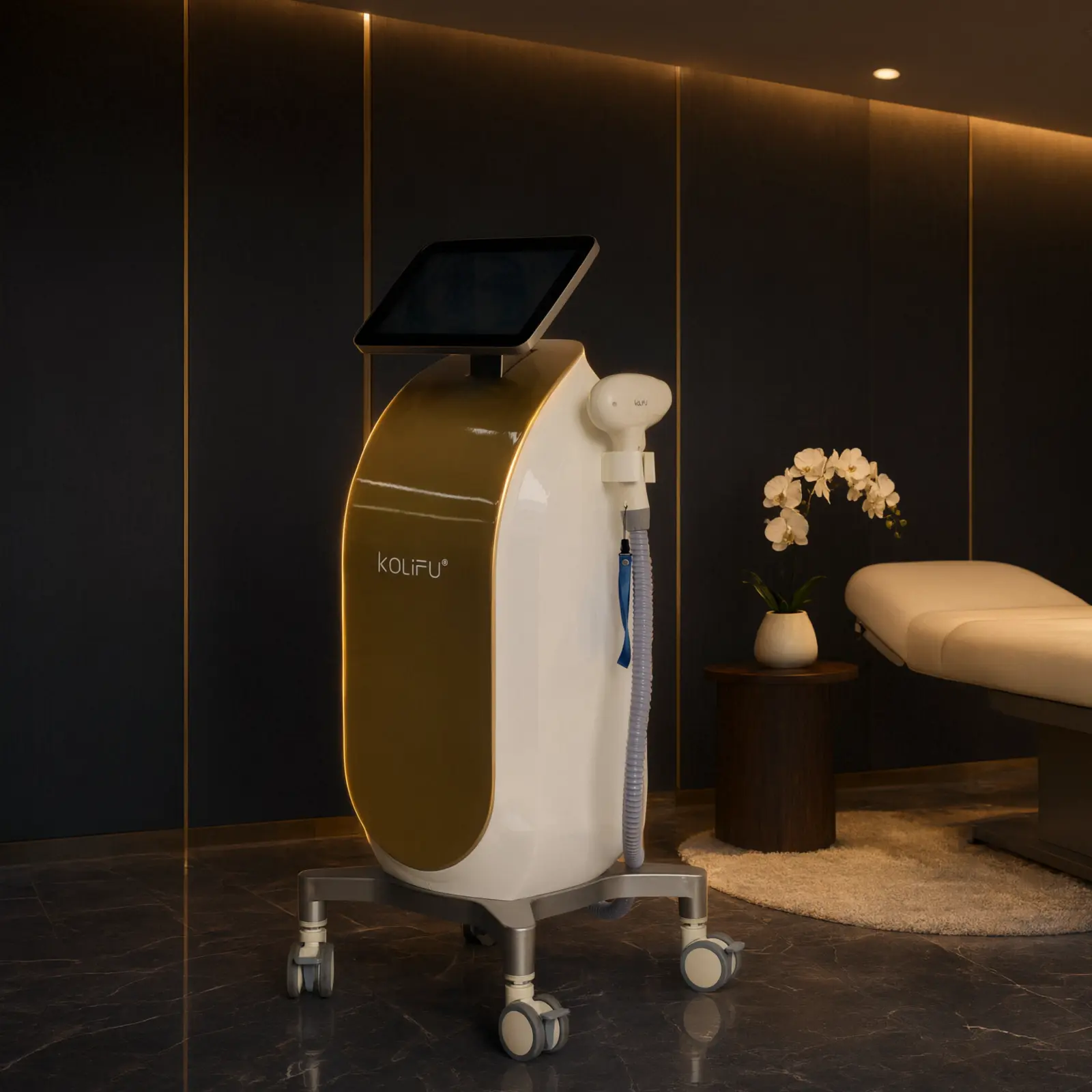
KOLIFU 808nm DIODE LASER
800W single-wavelength 808nm diode platform with advanced contact cooling, engineered for fast full-body treatments across all Fitzpatrick skin types.
View the 808nm diode laser →Verified Specifications
| Specification | Value |
|---|---|
| Wavelength | 808nm |
| Power output | 800W |
| Technology | Diode Laser |
| Cooling system | Advanced Contact Cooling |
| Treatment areas | Full Body |
| Skin types | All Skin Types (Fitzpatrick I–VI) |
What You Get With the Machine
800W high power output. The system delivers rapid, high-energy pulses so full-body sessions finish in fewer passes — which is what actually raises your daily client capacity.
Effective on all skin types. The 808nm wavelength targets the follicle across a wide range of skin tones and hair colors, so you are not turning clients away.
Maximum client comfort. Integrated contact cooling keeps the skin surface at a consistent low temperature through the pass, protecting the epidermis and making high-fluence treatment on darker skin tones practical.
Professional-grade precision. Consistent, repeatable energy delivery means predictable outcomes — the property that turns a treatment into a repeatable protocol you can train staff on.
Full technical documentation, handpiece options and current lead time are available on request.
Diode vs Alexandrite vs IPL: Different Laser Hair Removal Machines Compared
Wavelength choice is really skin-tone choice. Read your market before you read the price list.
| Technology | Typical wavelength | Best suited skin types | Practical notes |
|---|---|---|---|
| Diode laser | 808nm (some platforms add 755nm / 1064nm) | I–VI | The default professional choice. Balances depth and melanin absorption; works on the widest skin-tone range from one handpiece. Slower than alexandrite on very fine hair. |
| Alexandrite laser | 755nm | I–III | Fastest on fine and light hair, but epidermal melanin competes for the energy — higher risk on tanned or darker skin. |
| Nd:YAG laser | 1064nm | V–VI | Safest for very dark skin, but needs higher energy and more sessions, and is less effective on fine hair. |
| IPL | Broadband (500–1200nm) | I–IV | Not a laser — a filtered flash. Less selective, more sessions, generally lower equipment cost. Common in salons, less so in clinical settings. |
Most clinics that compare different laser hair removal machines end up choosing a diode platform, and the reason is coverage rather than peak performance: one 808nm handpiece serves nearly every client who walks in. Alexandrite is a fair argument if your clientele is overwhelmingly fair-skinned and you are optimising for session speed. An IPL laser hair removal machine is a different conversation entirely — it is a lower-cost entry point with a lower ceiling, and it competes on price rather than on results.
What Drives the Cost of a Laser Hair Removal Machine
The headline price tells you the least. These five factors tell you the most.
Buyers researching laser hair removal machine price usually find a very wide spread — and the spread is real, because the machines underneath it are not the same product. A laser hair removal equipment prices comparison only becomes meaningful once you normalise for five things.
| Cost factor | Why it moves the price |
|---|---|
| Power and duty cycle | A machine rated for continuous clinical operation costs more than one rated for intermittent use. This is the difference between a salon device and a commercial laser hair removal machine. |
| Wavelength count | Single-wavelength 808nm systems are the most cost-efficient route to full skin-tone coverage. Adding 755nm and 1064nm raises cost and adds capability you may not need. |
| Cooling architecture | Integrated contact cooling is engineered into the handpiece, not bolted on. It is one of the largest single cost components and one of the largest comfort drivers. |
| Laser bar and consumables | Bar quality sets both the achievable output and the service life. Cheaper bars mean more downtime and an earlier replacement — a cost that arrives after the invoice. |
| Supplier layer | Every trading company between you and the factory adds margin without adding capability. Factory-direct pricing removes that layer and usually comes with better parts access. |
For reference, the KOLIFU 808nm diode laser carries a guide price of $5,300 at factory-direct level, with volume tiers for distributors and multi-unit clinic groups. If you are working out how much is a laser hair removal machine for your own market, budget for handpiece spares, training and shipping alongside the unit itself — for a laser hair removal machine professional clinics should treat those as part of the purchase price, not as afterthoughts. Comparing laser hair removal machines professional operators already run day to day is more informative than comparing watts on a spec sheet, because the machines that look cheapest on the quotation often are not cheapest over three years of operation. Message us on WhatsApp and we will break the cost down line by line for your market.
Applications and Treatment Menu
The 808nm diode laser is designed for full-body hair removal, and it covers the treatments that actually generate repeat bookings: full body hair removal, facial hair reduction, underarms, bikini line, legs, back and chest, and arms. Because a single session covers a large area quickly, the same machine supports both short express appointments and full-body packages — which is what makes it work as a first laser purchase for a growing clinic.
If your treatment menu also includes pigmentation or tattoo removal, that is a different wavelength requirement. KOLIFU supplies the GOLDEN FANO Pico Laser for tattoo and pigment work and the KOLI CO2 Laser for resurfacing, so a clinic can build a hair removal service first and add a laser line later without changing suppliers. See the full laser machines range for the overlap between the three.
Frequently Asked Questions
Related Equipment
ALL LASER MACHINES
Compare the three KOLIFU laser lines — 808nm diode hair removal, picosecond tattoo and pigment, and fractional CO2 resurfacing.
View laser machines →GOLDEN FANO PICO LASER
Picosecond platform for tattoo removal and pigmentation — the companion purchase to a hair removal laser.
View pico laser →KOLI CO2 LASER
Fractional CO2 for skin resurfacing, with a dual facial and intimate positioning for clinics extending their laser menu.
View CO2 laser →Get a Factory-Direct Quote
Tell us your market, client volume and treatment menu — we will confirm the right 808nm configuration and send factory pricing within 24 hours.
Request a Quote